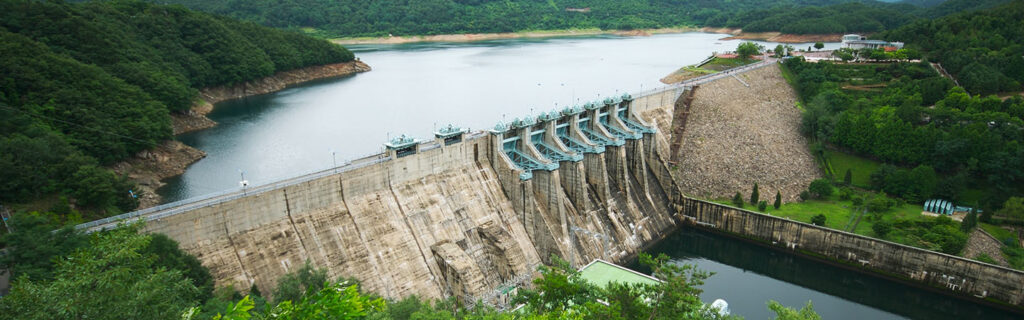
Expanding on the K-Water project in South Korea with emphasis on industrial maintenance efficiency
Hydroelectric plants are critical components of the global energy infrastructure, converting the kinetic energy of flowing water into renewable electricity for millions of people. These large-scale facilities rely on complex mechanical systems, including generators and turbines, which use lubricants and hydraulic oils essential for smooth operation.
However, even minor lubrication oil leaks can compromise both environmental safety and operational continuity. When turbine bearing oils escape into overflow pits or effluent channels, they can rapidly enter sensitive river systems and reservoirs, posing environmental, regulatory, and financial risks. Unlike visible spills in open marine environments, these leaks are often subtle and difficult to detect with traditional monitoring techniques, leaving operators unaware until contamination becomes significant.
The Challenge: Detecting Oil Contamination Before It Escalates
Turbine oil leaks in hydroelectric plants can originate from several sources, including worn bearing seals, deteriorating hydraulic lines, or improper maintenance. Without continuous monitoring, these issues may go unnoticed until they result in:
- Environmental contamination of rivers and downstream ecosystems
- Increased maintenance costs and unplanned shutdowns
- Reduced lifespan of critical components
- Regulatory and reputational pressures for operators responsible for national water resources
Traditional periodic sampling or manual inspections are often insufficient in high-flow, dynamic water systems typical of hydroelectric installations. These approaches lack the immediacy and sensitivity required to detect small oil films before they disperse, making real-time monitoring an operational imperative.
The K-Water Case: Proactive Monitoring at Imha and Daecheong Plants
To address these challenges, K-Water, one of South Korea’s largest utility companies, deployed the ROW (Remote Optical Watcher) oil spill detection system at its Imha and Daecheong hydroelectric power plants. Situated on major river systems that supply treated water to millions and support industrial users, these facilities required a robust and continuous monitoring solution to protect both infrastructure and local water quality.
Unlike traditional systems, ROW provides 24/7 real-time surveillance of water bodies by leveraging advanced optical technology. At K-Water’s plants, sensors were strategically positioned in overflow pits and effluent channels where turbine oils are most likely to escape. This configuration enables immediate detection of hydrocarbon contamination before it disperses into broader water networks.
How Non-Contact Optical Monitoring Works
The ROW system employs UV-induced fluorescence to detect oil presence on water surfaces. When ultraviolet light illuminates the water, hydrocarbon molecules emit a distinct fluorescence signature that can be identified by the sensor without physical contact. This non-contact detection method offers several key advantages:
- High sensitivity, capable of detecting oil films as thin as 1 micron
- Maintenance-free operation, with no direct exposure to water or fouling
- All-weather performance with robust IP68-rated enclosures
- Flexible integration with telemetry systems for real-time alerts
By eliminating the need for probes or sampling, ROW reduces routine maintenance burdens and provides reliable performance even in high-turbulence environments typical of hydroelectric overflow pits.
Enhancing Industrial Maintenance Efficiency
Continuous monitoring at hydroelectric facilities goes beyond spill detection. It plays an active role in industrial maintenance optimization. For K-Water, early detection of oil leaks enables operators to intervene before minor issues escalate into major failures. This proactive approach yields several tangible benefits:
- Reduced unplanned downtime, as issues are addressed before causing breakdowns
- Extended equipment lifespan, through early identification of lubrication anomalies
- Lower operational costs, by avoiding expensive repairs and environmental fines
- Improved operational visibility, via real-time data that supports maintenance planning
By integrating continuous monitoring with data analytics and automated alerts, hydroelectric operators can shift from reactive troubleshooting to predictive maintenance workflows, ultimately enhancing both safety and operational efficiency.
Real-Time Alerts and Integration
At the core of ROW’s industrial value is its ability to issue real-time alerts. When hydrocarbon signatures are detected, the system can send immediate notifications via SMS, email, or direct integration into a plant’s existing monitoring infrastructure. This enables maintenance teams and operational control rooms to act swiftly, minimizing the window between detection and intervention.
Furthermore, ROW’s compatibility with standard telemetry protocols such as RS-485 (Modbus), 4–20 mA, and relay outputs ensures that collected data integrates seamlessly with supervisory control and data acquisition (SCADA) systems. Such integration allows for centralized visualization and historical trend analysis, further supporting maintenance decision-making.
From Detection to Operational Resilience
The K-Water implementation of continuous oil monitoring underscores how advanced detection technologies like ROW can reinvent safety and maintenance in hydroelectric plants. By detecting oil leaks in real time and enabling early intervention, operators can protect both water quality and the integrity of critical power generation infrastructure.
In an era where environmental compliance, operational efficiency, and sustainability are paramount, continuous water monitoring systems provide a strategic advantage, transforming maintenance practices, reducing risks, and reinforcing the resilience of renewable energy assets worldwide.