Palm oil is one of the most widely traded commodities in Southeast Asia. Indonesia and Malaysia together account for roughly 85% of global production, with thousands of tonnes processed daily across extraction mills, refining facilities and oleochemical plants.
In each of these environments, process water comes into contact with palm oil at multiple stages and the risk of hydrocarbon discharge into surrounding waterways is continuous, not incidental.
The monitoring challenge is specific: palm oil is not a petroleum product and detection systems calibrated for mineral hydrocarbons will not respond to it.
What is needed is a sensor that exploits the physical properties of palm oil itself: UV-induced fluorescence provides exactly that basis.
Why Palm Oil Fluoresces and Why That Matters for Detection
Vegetable oils, including palm oil, are glycerol esters of fatty acids. Unlike mineral hydrocarbons, which fluoresce primarily due to their aromatic ring structures, vegetable oils carry a different set of fluorescent compounds: chlorophyll residues retained from the raw fruit, tocopherols (vitamin E), polyphenols and oxidation products formed during processing and storage.
Each of these components absorbs UV light and emits a characteristic fluorescence signature. This means that when the ROW sensor illuminates the water surface with UV, palm oil (whether raw or refined) produces a measurable optical return that is distinct from background water signal.
The key detection metric is the Signal-to-Noise Ratio (SNR): the ratio of signal intensity from the oil film to the baseline signal from water, accounting for natural surface fluctuation. The limit of detection (LOD) is defined at SNR ≥ 3. Tthe statistical threshold at which the presence of oil can be confirmed with confidence under defined conditions of film thickness, distance, and ambient light.
Laboratory characterization conducted by LDI’s chemistry team confirmed that the standard ROW model O-2311A detects both refined and raw palm oil as surface films on water at 1 meter distance, with SNR values above the LOD threshold. A consistent finding across the full test set of vegetable oils was that refined oils produce higher SNR than unrefined equivalents. The refining process removes pigments and impurities, including chlorophyll, which partially quenches fluorescent emission, resulting in a cleaner, stronger and more uniform signal. For palm oil specifically, this means that both the crude product present in extraction mills and the refined product handled in downstream processing facilities fall within the sensor’s confirmed detection range, with refined palm oil offering somewhat better detection performance.
The Industrial Context: Where Leaks Occur and Why They Are Difficult to Catch
Palm oil processing involves several distinct stages, each generating process water contaminated at different concentration levels:
In crude palm oil (CPO) extraction mills, fresh fruit bunches are steamed and pressed. The resulting palm oil mill effluent (POME) is one of the highest-BOD industrial wastewaters generated in the agricultural sector. While large-volume POME is managed through dedicated effluent treatment systems, minor leaks from pressing equipment, conveyors and collection channels represent a persistent low-level contamination risk at discharge points.
In refining facilities, crude palm oil undergoes degumming, bleaching and deodorization. Process water used in washing stages and steam stripping exits with residual oil content. Equipment seal failures, pump leaks, and overflow events at transfer points are the most common sources of uncontrolled discharge.
In both contexts, the contamination typically enters waterways as a thin surface film (in the 1–100 micron range) rather than as a visible bulk spill. At these thicknesses, visual inspection is unreliable, periodic grab sampling misses intermittent events and immersed probe sensors accumulate biological fouling in the warm, nutrient-rich effluent environments typical of Southeast Asian mill sites.
Environmental Impact: Why Early Detection Is Operationally and Regulatorily Critical
Palm oil’s environmental profile in water is more complex than its biodegradable origin might suggest.
Three mechanisms drive its impact:
High BOD loading: as vegetable oils biodegrade, they consume dissolved oxygen rapidly, creating anoxic zones in receiving waterways where aquatic life cannot survive. POME has a BOD of approximately 25,000 mg/L untreated, orders of magnitude above the threshold for aquatic ecosystem disruption.
Surface smothering: even thin oil films coat the gill surfaces of fish and the respiratory surfaces of benthic organisms, causing asphyxiation at concentrations that produce no visible sheen detectable by eye.
Polymerization: vegetable oils exposed to oxygen can polymerize over time, forming rubbery, hydrophobic crusts on sediment surfaces that resist biodegradation and persist in the environment for years.
In Indonesia and Malaysia discharge limits for palm oil effluent are set under national environmental legislation, with BOD and oil-and-grease limits enforced at mill and refinery outlets. Non-compliant discharge events carry both regulatory penalties and increasingly supply chain consequences, as European buyers apply sustainability screening to upstream operations regardless of whether palm oil itself is sold into European markets.
ROW Deployment in Palm Oil Facilities
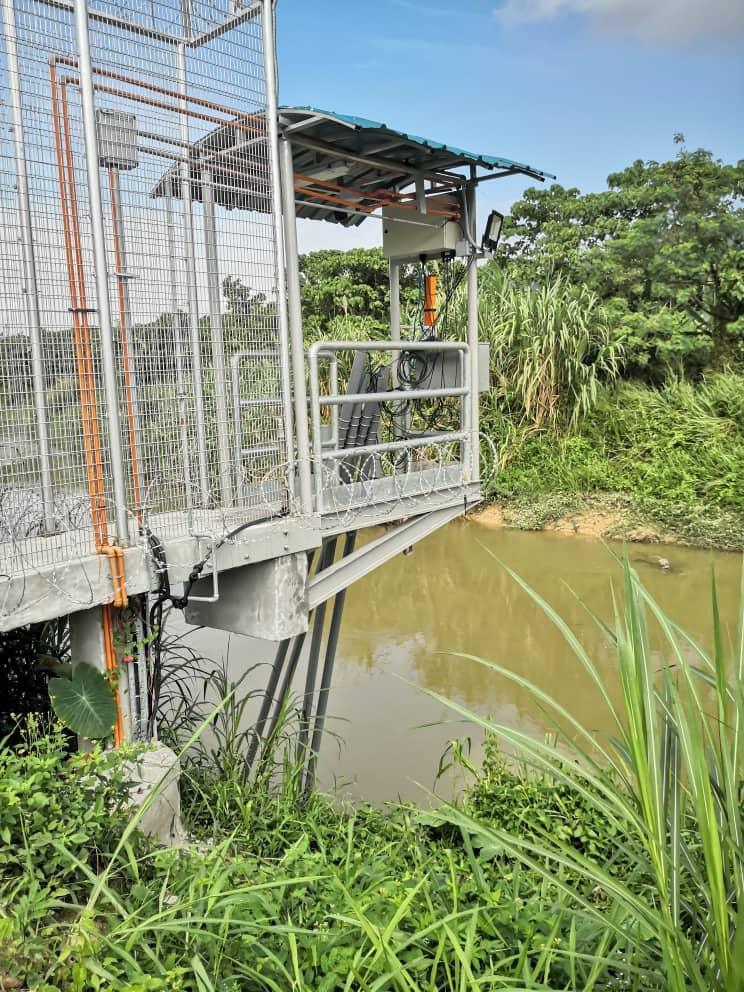
The standard ROW model O-2311A is the configuration that has been successfully deployed in palm oil refineries across Southeast Asia for discharge monitoring. It installs above the water surface (no contact with the effluent, no fouling from the high-organic-content water) and operates continuously at under 2W, making it compatible with solar-powered installations at remote mill sites without grid access.
Output is via 4–20 mA or RS-485 Modbus, allowing direct integration into facility SCADA systems or standalone alarm relay circuits. Detection is continuous and real-time: when a palm oil film above the LOD threshold appears at the monitored discharge point, the alarm triggers within seconds not after the next scheduled sampling round.
For facilities with multiple discharge points (collection channels, settlement pond outlets and final effluent outfalls) a network of ROW sensors connected via RS-485 can cover the full site perimeter from a single monitoring interface, with up to 99 devices addressable on a single bus.