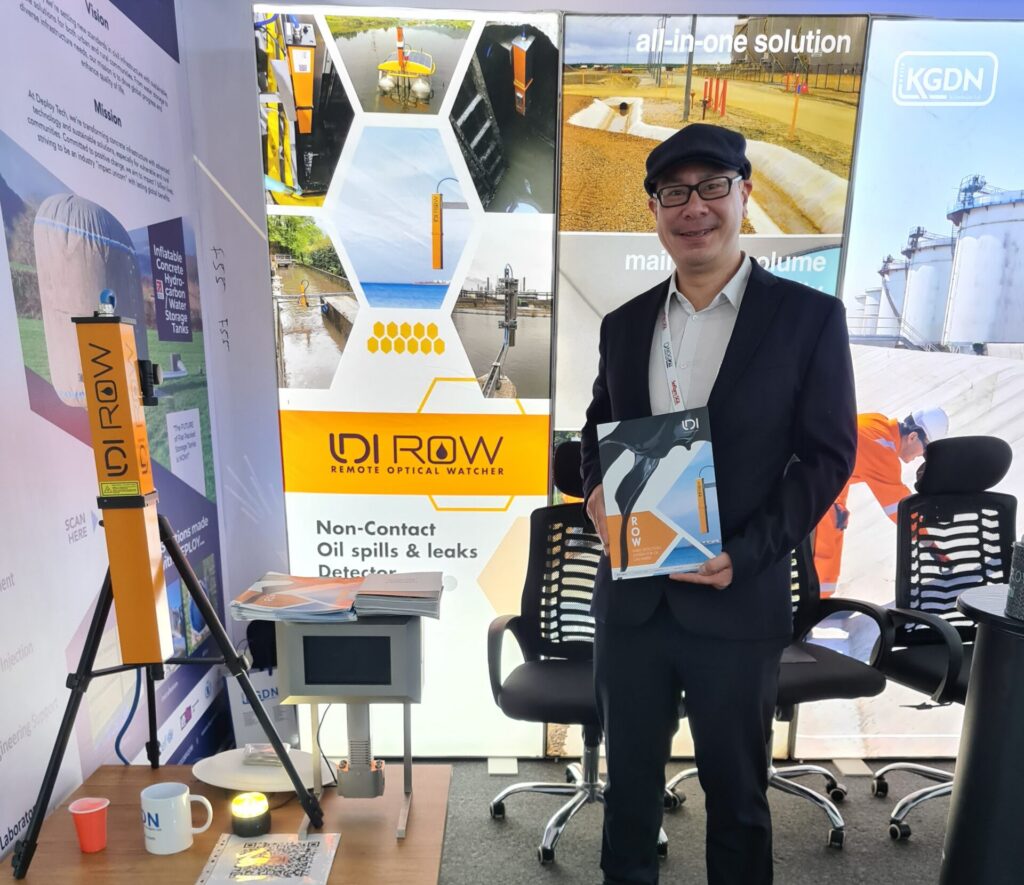
Nigeria is one of Sub-Saharan Africa’s most significant oil and gas producers, and the infrastructure that moves that oil (Single Buoy Moorings, FPSOs, offshore transfer systems) represents both the backbone of the industry and one of its most persistent environmental monitoring challenges.
Last week at NOG Energy Week 2026 in Abuja, together with our Nigerian distributor KGDN Technologies, we had the opportunity to discuss that challenge directly with the operators and engineers who manage it every day.
The conversations were consistent enough to be worth documenting.
What NOG 2026 Looked Like From the Exhibition Floor
NOG Energy Week 2026 marked the event’s 25th anniversary, attracting around 7,500 visitors and 300 exhibitors, making it the largest energy exhibition in Sub-Saharan Africa. The theme this year, Advancing Energy Ambitions for Competitive and Resilient Economies, reflected an industry that is simultaneously managing production growth, cost pressure and tightening environmental obligations under Nigeria’s Petroleum Industry Act.
At Booth F87, alongside KGDN and fellow exhibitors Enviro-Tech (USA) and Inov8 (UK), the discussions we had covered a wide range of application scenarios, but one topic came up consistently across conversations with Shell, Renaissance, ExxonMobil, TotalEnergies and engineering firms including DBN Energies, Adano Engineering, Mamtech, and RockView Engineering: reliable oil spill detection at offshore facilities, particularly at SBMs and FPSOs.
That focus isn’t accidental. It reflects where the real monitoring gap sits in Nigeria’s upstream infrastructure.
The Specific Problem at SBMs and FPSOs
A Single Buoy Mooring (SBM), also known as a single-point mooring (SPM), is a loading buoy anchored offshore that serves as a mooring point and interconnect for tankers loading or offloading gas or liquid products, the link between geostatic subsea manifold connections and weathervaning tankers, capable of handling vessels up to very large crude carrier (VLCC) tonnage.
The transfer operation itself is where the spill risk is concentrated. Floating hose strings connect the buoy to the offloading tanker and during connection, disconnection and active transfer, the potential for hydrocarbon release at the water surface is at its highest.
In calm conditions, this is a manageable risk. In the dynamic offshore environment typical of Nigeria’s Atlantic-facing coastline with wave action, vessel movement and variable currents, the same operation generates a more complex monitoring requirement.
FPSOs (Floating Production, Storage and Offloading vessels) present a related but distinct challenge. Unlike fixed platforms, FPSOs are continuously moored in open water, processing and storing crude oil before offloading to shuttle tankers. Every stage of that cycle, production, storage and transfer, creates potential vectors for hydrocarbon contamination of the surrounding water. Continuous monitoring of the water surface around an FPSO is not a compliance exercise; it is the only way to detect minor leaks from hull penetrations, process drains or hose connections before they become reportable spill events.
The monitoring challenge in both cases shares three characteristics that define the sensor requirements: the installation is offshore with limited maintenance access, power is constrained by what the buoy or vessel’s solar and battery systems can provide and the sea state is dynamic, with wave motion introducing both physical variability in oil film distribution and optical noise in any sensor relying on surface reflection.
Why Non-Contact Optical Monitoring Fits This Application
The ROW sensor was designed around exactly these constraints, and the NOG conversations confirmed that operators understand the distinction between contact and non-contact sensing in offshore conditions.
Contact-type sensors (immersed probes, float-based detectors) accumulate biofouling in warm, productive offshore waters. Nigeria’s Atlantic coast sits at tropical latitudes where biological activity in the surface layer is high year-round. A sensor with any part in contact with the water requires regular cleaning to maintain calibration, which is precisely the intervention that is difficult and expensive on a remote SBM or FPSO. A non-contact sensor that operates from above the water surface has no fouling problem to manage.
The ROW detects hydrocarbon films through UV-induced fluorescence: the sensor illuminates the water surface with UV light and hydrocarbon molecules respond with a characteristic fluorescence emission that is measured and quantified in real time. No contact with the water, no reagents, no moving parts. Detection starts at 1 micron film thickness, the range where surface contamination is physically present but not yet visible to the eye or detectable by conventional sampling. Power draw is under 2W, which fits within the energy budget of a solar-powered buoy system without compromising the other instrumentation on board. The IP68-rated, Argon-purged enclosure handles the salt spray, humidity and wave exposure of a permanent offshore installation.
For SBM monitoring specifically, the ROW can be mounted on the buoy structure itself, oriented toward the water surface at the hose connection point where spill risk is highest. For FPSO perimeter monitoring, multiple units networked via RS-485 Modbus can cover different sectors of the vessel’s waterline from a single SCADA integration point, with up to 99 devices addressable on a single bus.
The Regulatory Context in Nigeria
The Petroleum Industry Act (PIA), which came into force in 2021, consolidated Nigeria’s upstream environmental obligations under a single regulatory framework. The Federal Ministry of Environment regulates the environmental aspects of oil operations, including the administration of environmental impact assessments and environmental compliance approvals for petroleum projects. Offshore operators in Nigeria are required to monitor for and report hydrocarbon discharges, and the trend in enforcement consistent with what we heard at NOG is toward more rigorous documentation of continuous monitoring rather than periodic reporting.
Continuous real-time monitoring at SBMs and FPSOs isn’t just a better technical solution than periodic sampling, it’s increasingly the standard that major operators apply to their own internal requirements, independent of minimum regulatory thresholds. Shell, TotalEnergies and ExxonMobil all operate under their own environmental management standards that exceed local regulatory minimums and the conversations at NOG reflected an awareness that monitoring infrastructure needs to match those standards.
What Comes Next
NOG 2026 confirmed that the demand for reliable offshore oil spill detection in Nigeria is real, specific and technically informed. The operators and EPCs we met with understand the limitations of conventional monitoring approaches in offshore conditions and they are looking for solutions that can operate continuously, integrate into existing data infrastructure, and survive the marine environment without adding to maintenance workload.
We’ll be following up directly with the contacts made at the exhibition to discuss specific installation configurations for SBM and FPSO applications.
If you’re working on a similar offshore monitoring requirement and want to discuss the technical details, get in touch with the LDI team.