Cooling water systems are essential to the operation of power plants, refineries and many industrial facilities. By removing excess heat from equipment and production processes, these systems help maintain operating temperatures and protect critical infrastructure.
However, cooling water circuits can also become potential pathways for hydrocarbon contamination. Leaks from oil-lubricated equipment, heat exchangers or adjacent industrial processes may allow hydrocarbons to enter the water stream and eventually reach discharge channels or receiving waters.
For engineers responsible for environmental monitoring, the challenge is not simply detecting oil, but identifying where contamination is most likely to occur and selecting monitoring points that provide an effective opportunity for early detection.
How Hydrocarbons Can Enter Cooling Water Circuits
The potential sources of contamination depend on the design and operation of the cooling system.
In industrial heat exchangers, for example, a loss of integrity between process and cooling-water circuits can allow hydrocarbons to migrate into the water, depending on the pressure differential between the two sides. Other potential sources include equipment leaks, contaminated drainage connections and accidental releases near open cooling channels or collection basins.
Once hydrocarbons enter the system, their behaviour depends on several factors, including oil density, water velocity, turbulence and the geometry of the flow path. Lighter hydrocarbons may rise and spread across the water surface, while turbulent conditions can disperse some of the oil into droplets within the water column. This distinction is particularly important for surface oil detection technologies, since the presence and distribution of a surface film determine whether contamination can be detected at a specific monitoring location.
Identifying Critical Monitoring Points
Selecting an appropriate detection point requires an understanding of the cooling water circuit and its potential contamination pathways.
In many installations, relevant monitoring locations may include:
- Downstream of heat exchangers: where leaks between process fluids and cooling water could introduce hydrocarbons into the circuit.
- Cooling water collection basins: where floating hydrocarbons may accumulate under suitable hydraulic conditions.
- Open discharge channels: where surface contamination can be monitored before water leaves the industrial facility.
- Final discharge points: where monitoring can support the detection of oil films before they enter receiving waters.
The most suitable location depends on the objective of the monitoring system.
A detector installed close to a potential contamination source may provide earlier warning, while monitoring at a final discharge point can cover several upstream contamination pathways.
However, a single downstream detector may not identify which part of the system caused the contamination. For complex installations, multiple monitoring points may therefore be appropriate.
Engineering Considerations for Non-Contact Oil Detection
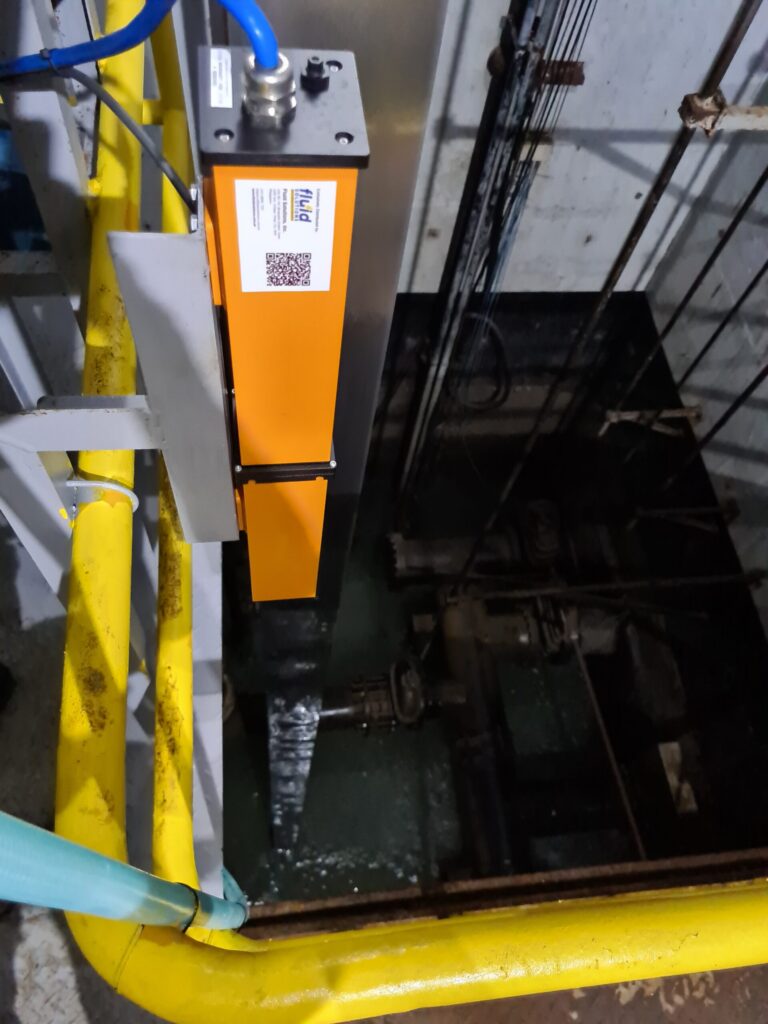
When using optical oil detection technology such as LDI’s ROW, installation conditions must be evaluated alongside the location of potential hydrocarbon sources.
ROW uses UV-induced fluorescence to detect oil films on the water surface without requiring direct contact with the monitored liquid.
For cooling water applications, several operating conditions influence the suitability of a monitoring point.
Water flow and turbulence: High flow velocities, splashing or strongly turbulent sections may prevent a stable surface film from forming at the measurement location.
Water-level variations: Changes in operating conditions can alter the distance between the detector and the water surface. The installation must remain within the sensor’s specified operating range.
Surface accumulation: Channel bends, collection areas and hydraulic structures can influence where floating hydrocarbons concentrate or disperse. These conditions should be evaluated before selecting the sensor position.
Maintenance and accessibility: The installation should allow safe access for inspection, configuration and maintenance without interfering with normal plant operations.
In some applications, positioning the detector above a relatively calm section of the water circuit may provide more suitable conditions than installing it directly over a highly turbulent discharge.
Integrating Oil Detection into Plant Monitoring
In industrial facilities, detecting contamination is only useful if the information reaches the appropriate personnel or control system.
ROW supports integration through relay outputs, 4–20 mA signals and RS-485 Modbus communication, allowing oil detection alarms to be incorporated into existing PLC or SCADA architectures.
Depending on the monitoring strategy, an alarm can notify operators of potential contamination and support further investigation of the affected cooling water circuit.
For installations with multiple monitoring points, centralized data collection can also help operators identify which monitored section has registered an event.
Designing Monitoring Around the Actual Risk
Effective oil spill monitoring in cooling water systems begins with an understanding of the plant’s hydraulic layout, potential contamination sources and discharge infrastructure.
Sensor sensitivity alone cannot compensate for an unsuitable monitoring location. A detector must be positioned where the contamination it is intended to identify is likely to pass through its measurement area.
By combining appropriate monitoring-point selection, non-contact optical detection and integration with existing control systems, industrial facilities can improve their ability to identify surface hydrocarbon contamination and respond to potential releases.
For engineers, the objective is to develop a monitoring architecture that reflects the actual operating conditions of the cooling water system rather than applying the same detector configuration to every installation.