There is a category of water monitoring environment where the choice of sensor architecture matters more than almost any other specification: warm, nutrient-rich water with high biological activity. Algal blooms, eutrophic industrial channels, tropical coastal sites, wastewater treatment effluent, anywhere that biological productivity is high, the performance gap between immersed contact sensors and non-contact optical monitoring becomes the dominant factor in long-term system reliability.
Understanding why requires looking at what biofouling actually does to a sensor, how fast it happens and what the engineering responses to it cost in practice.
The Biology of the Problem
Biofouling on a submerged sensor is not a single event. It is a staged colonization process that begins the moment the sensor enters the water and progresses predictably through phases of increasing severity.
Within minutes of immersion, dissolved organic molecules in the water adsorb onto the sensor surface, forming a conditioning film that alters the surface’s chemical properties and makes it more hospitable to microbial attachment. Within hours, bacteria exploit this conditioned surface and begin forming biofilms, structured communities of microorganisms embedded in a self-produced extracellular polymer matrix.
Once the bacterial biofilm is established, it acts as a substrate for higher organisms: macrofouling organisms (barnacles, mussels, algae) colonize within days to weeks.
For a contact-type oil sensor with a probe, float or optical window in contact with the water, this progression is the central operational problem. For a large percentage of deployed instrumentation, biofouling is the single biggest factor affecting operation, maintenance and data quality. The fouling doesn’t just coat the housing, it directly interferes with the measurement. Upon seawater immersion, optical sensors invariably experience colonization by marine organisms within hours, and biofilm formation covering optical windows or transparent housings severely compromises measurement performance.
The timeline is short and unforgiving. Research on moored optical sensors in coastal waters shows that without active antifouling measures, immersed optical sensors in coastal waters show significant measurement degradation within 10 days of deployment. In high-productivity algal environments, the exact conditions most relevant to eutrophic industrial channels and water treatment applications, that timeline compresses further.
What Biofouling Does to a Contact Oil Sensor
For an immersed oil detection probe, biofouling creates three distinct failure modes, each with different operational consequences.
Signal masking. A biofilm on the sensing surface introduces its own optical signal: fluorescence from the biological material, absorption of the excitation light and scattering that reduces the effective sensitivity of the measurement. The sensor is no longer measuring the water; it is measuring the layer of organisms that has grown between it and the water. In the context of oil detection, this means that the fluorescence signature of hydrocarbons at the detection surface is partially absorbed and scattered by the biofilm before it reaches the detector, raising the effective detection threshold and potentially causing the sensor to miss thin-film contamination events entirely.
Calibration drift. Long-term immersion experiments confirmed that biofouling significantly reduced sensor accuracy, with accuracy reductions of fouled sensors exceeding 50% for some parameters after extended deployment. For a sensor calibrated to produce an alarm at a specific fluorescence threshold, drift of this magnitude means the calibration is no longer valid, the sensor may produce false negatives on real contamination events or false alarms from the biological signal itself.
Mechanical interference. Float-based sensors that sit at the water surface to detect oil films accumulate biofouling on the float body and any moving parts. In algae-rich environments, macroalgae growth on floats alters buoyancy, changes the sensor’s orientation relative to the water surface and in advanced cases physically displaces the sensor from the position required for accurate measurement.
The Engineering Responses and Their Costs
The water quality monitoring industry has developed several approaches to extend the deployment life of immersed sensors in biofouling-prone environments. Each carries specific costs and limitations.
Mechanical wipers are the most common solution for sensors with optical windows. A rotating or reciprocating wiper clears the window surface at set intervals, removing the biofilm before it accumulates to the point of measurement interference. Wipers extend deployment periods meaningfully, but they introduce a moving part that requires its own maintenance, can scratch optical surfaces over time, and critically can themselves become fouling substrates. In high-biofouling environments, the wiper mechanism accumulates biological material between cleaning cycles and can redistribute rather than remove it.
Antifouling coatings applied to sensor housings and optical windows reduce the rate of initial colonization. Research on copper-based systems showed that copper tubing used with immersed optical sensors extended functional measurement capability from approximately 10 days to more than 60 days in coastal waters. However, antifouling coatings cannot be applied directly to active sensing surfaces without interfering with measurement, and conventional toxic metal biocides such as tributyltin face tightening international regulatory pressure that limits their applicability in industrial and environmental monitoring contexts.
Increased maintenance frequency is the fallback. When fouling outpaces the sensor’s antifouling capability, the operational response is to schedule more frequent cleaning and recalibration interventions. In accessible locations, like a water treatment plant channel or a harbor wall, this may be manageable. At remote or difficult-access sites (offshore installations, remote river monitoring points, wastewater discharge channels in industrial facilities) the cost of maintenance visits quickly becomes the dominant operational expense of the monitoring system.
Non-Contact Optical Monitoring: Eliminating the Contact Problem
The architectural response to biofouling is not to manage it more effectively on an immersed sensor. It is to remove the sensor from the water entirely.
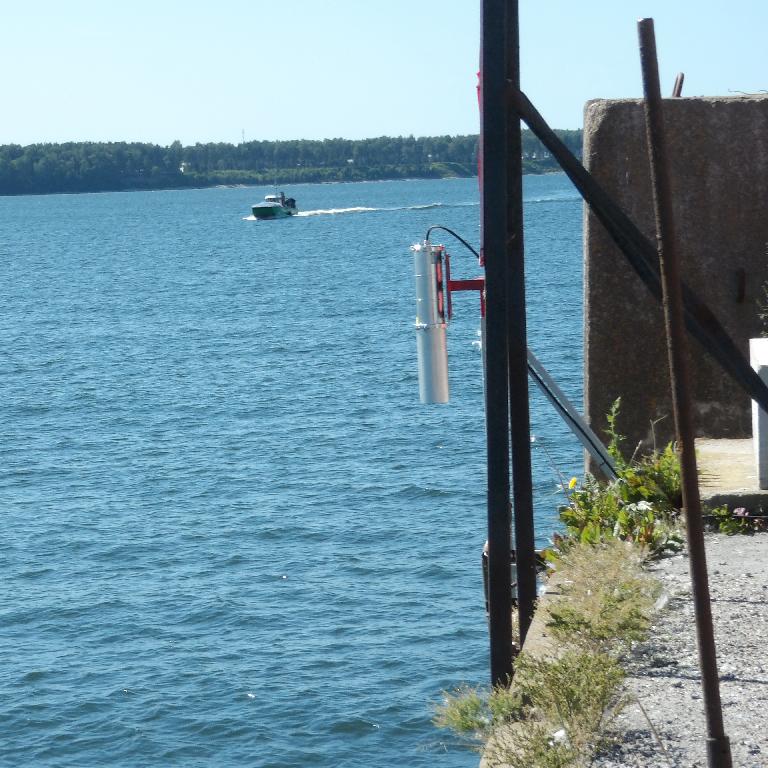
Non-contact optical monitoring, as implemented in the ROW sensor, operates from above the water surface. The UV source and detector are housed in a sealed enclosure mounted at a distance of 2–10 meters from the water. No part of the sensor touches the water at any point in its operational life. There is no surface for biofilm to colonize within the measurement path, no optical window in contact with the aquatic environment, no float that algae can grow on and no wiper mechanism to maintain.
The detection principle, UV-induced fluorescence of hydrocarbon molecules on the water surface, operates across the air/water interface. The sensor illuminates the surface and measures the fluorescent return from above. The only environmental exposure is to air, humidity and atmospheric conditions, all of which the IP68-rated, Argon-purged enclosure is designed to handle without maintenance intervention.
The practical consequence for high-biofouling environments is significant. The ROW’s performance in an algae-rich tropical water treatment channel is not degraded relative to its performance in a clear harbor, because the biological content of the water has no path to the sensor’s measurement system. A sensor calibrated at commissioning remains at that calibration indefinitely.
Where the Difference Is Most Visible
The contrast between immersed and non-contact approaches is sharpest in environments that combine high biological productivity with infrequent maintenance access, which describes a large share of the monitoring applications where oil detection matters most.
Eutrophic industrial discharge channels, where nutrient-rich process water supports rapid algal growth, are a primary example. Wastewater treatment facilities, particularly at the pre-treatment stage where oil monitoring protects downstream biological treatment processes, operate in exactly the high-BOD, high-productivity water conditions that drive accelerated biofouling.
Tropical and subtropical coastal sites (palm oil refinery discharge channels in Southeast Asia, desalination plant intakes in the Persian Gulf, offshore monitoring buoys in equatorial waters) combine warm temperatures with high biological activity, creating biofouling conditions that compress the deployment lifetime of any immersed sensor.
In these environments, specifying a contact sensor with a wiper and a quarterly maintenance schedule is not a conservative choice. It is a system design that accepts periodic measurement gaps as a structural feature. Non-contact monitoring removes those gaps by removing the contact problem entirely.