Some installations are routine. Others sit at a point where a failure would have consequences far beyond the sensor itself.
The recent deployment at the Shuqiq Desalination Plant in Saudi Arabia falls firmly into the second category and it’s worth walking through exactly why and how the system was put together.
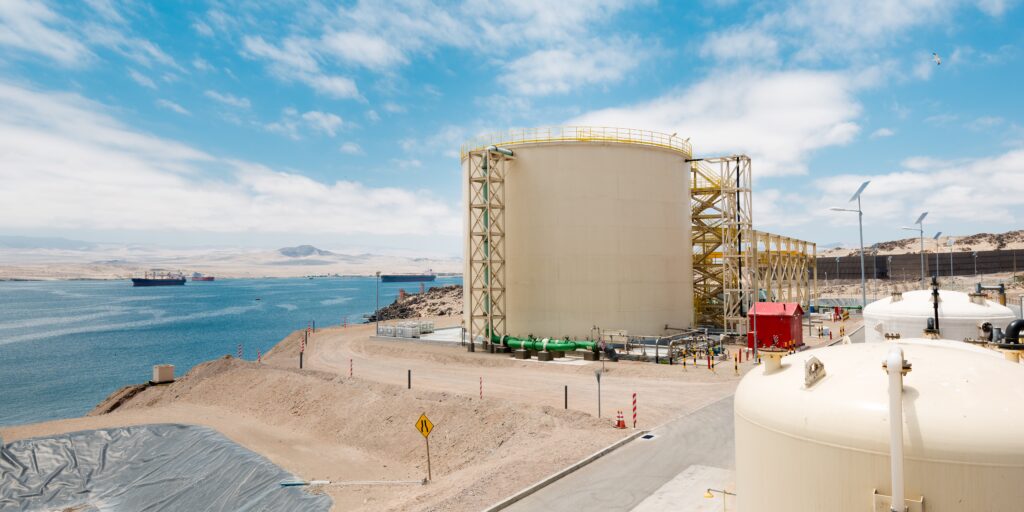
Xylem Analytics RIC UAE, the Gulf branch of Xylem (one of the world’s largest water technology corporations) has deployed a Xylem Oil Monitoring Data Buoy at the seawater intake of the Shuqiq Desalination Plant in Saudi Arabia, with LDI’s ROW sensor providing real-time oil spill detection as part of the monitoring system.
The installation combines four technologies into a single monitoring platform designed to protect one of the most critical points in a desalination facility: the seawater intake. The next buoy deployment is already scheduled, highlighting the continued expansion of this monitoring approach.
This project provides an excellent example of why intake monitoring is such a demanding application and why early hydrocarbon detection is essential for modern desalination infrastructure.
Why Seawater Intakes Require Continuous Monitoring
Seawater reverse osmosis (SWRO) has become the dominant desalination technology worldwide. At the heart of every SWRO plant are highly engineered membrane systems designed to remove dissolved salts while allowing water molecules to pass through.
These membranes deliver exceptional performance but are also vulnerable to hydrocarbon contamination.
When oil reaches the membrane surface, it can adsorb onto the material, forming a layer that reduces water flux, accelerates biological fouling and, in severe cases, causes irreversible damage. Unlike routine fouling, hydrocarbon contamination is often difficult to remove through standard cleaning procedures, leading to increased maintenance costs and reduced membrane lifespan.
For desalination operators, preventing oil contamination from reaching the intake is therefore not simply an environmental objective. It is a critical operational requirement.
In regions where desalination provides the majority of the drinking water supply, maintaining uninterrupted plant performance becomes even more important.
A Challenging Marine Environment
The geography and maritime activity of the Persian Gulf compound the membrane vulnerability problem. The Gulf is shallow, semi-enclosed and carries some of the densest maritime traffic in the world: tanker routes, port operations and routine ship-to-ship fuel transfers, all occur in proximity to coastal desalination intakes.
This creates a hydrocarbon risk profile that is structural rather than episodic. It isn’t a question of whether a spill event near an intake will happen, but when and at what scale. A monitoring system at the intake needs to operate continuously, in real sea conditions, for the long term. Not as an occasional check, but as a permanent layer of protection.
The Monitoring System
The deployment at Shuqiq integrates four technologies into a single monitoring platform.
Xylem DB1750 Data Buoy: The DB1750 serves as the offshore monitoring platform. Designed for long-term environmental monitoring applications, the buoy provides a stable and reliable foundation for sensor deployment in marine environments.
LDI ROW Oil Spill Sensor: The ROW sensor provides the oil detection capability within the system.
Using UV-induced fluorescence technology, the sensor identifies hydrocarbons directly on the water surface without physical contact. When exposed to ultraviolet light, oil produces a characteristic fluorescence response that differs from seawater, allowing contamination to be detected in real time.
The ROW can detect oil films from approximately 1 micron thickness while operating with power consumption below 2 W. Its IP68-rated, hermetically sealed construction enables reliable operation in harsh marine environments with minimal maintenance requirements.
These characteristics make the ROW particularly suitable for deployment on solar-powered offshore monitoring platforms where energy efficiency and long-term reliability are essential.
Data Logger with Cellular Telemetry: The monitoring platform includes a data logger equipped with built-in cellular telemetry, enabling continuous transmission of sensor data from the offshore buoy to onshore operators.
This eliminates the need for direct wired connections while ensuring that monitoring information remains available in real time.
YSI HydroSphere Cloud Platform: Sensor data is visualized through the YSI HydroSphere cloud platform, providing operators with remote access to measurements, system status information and alarm notifications.
The platform enables continuous monitoring from any location while supporting rapid response to contamination events.
From Oil Detection to Response
The operational principle of the system is straightforward.
The ROW continuously monitors the water surface surrounding the intake structure. If hydrocarbon contamination appears, the fluorescence signal exceeds the alarm threshold and the sensor immediately reports the event.
The alert is transmitted through the telemetry system and displayed within the HydroSphere platform, allowing operators to respond before contamination reaches sensitive downstream infrastructure.
Compared to periodic sampling programs, continuous monitoring significantly reduces the time required to identify contamination events, helping operators take action before hydrocarbons reach the reverse osmosis process.
Why This Configuration Works
Each component within the monitoring platform serves a specific purpose.
The buoy provides a stable offshore deployment platform. The telemetry system enables remote communications. The cloud platform delivers visibility and alarms. The ROW sensor provides the critical capability of detecting hydrocarbons directly on the water surface in real time.
Together, these technologies create a monitoring solution specifically designed for one of the most demanding applications in industrial water infrastructure.
LDI is proud to be trusted by one of the world’s leading water solutions companies for such critical applications and to be working together with the Xylem team across multiple successful installations.